Category: Educational
Let’s be real: the photography landscape in 2026 looks a lot different than it did even two years ago. We’ve moved past the initial "is AI going to take my job?" panic and settled into a much more exciting reality: AI is actually giving us our lives back.
If you’re like me, you didn’t get into photography because you loved sitting in a dark room (or a brightly lit office) for twelve hours staring at 3,000 nearly identical frames from a wedding or a week-long trek through the best photography locations in Patagonia. You got into this because you love the click of the shutter and the thrill of the hunt for that perfect light.
Today, I want to walk you through the five AI tools that are currently dominating the industry and how you can use them to reclaim your time without sacrificing the "soul" of your work.
The State of AI Photography Trends in 2026
Before we dive into the tools, we need to address the elephant in the room: the debate between authentic art and AI generation. In 2026, the trend has shifted toward "Augmented Authenticity." We aren't necessarily using AI to create images from scratch; we’re using it to remove the friction of post-processing.
Whether you’re shooting with the latest mirrorless body or mastering iPhone photography techniques, your goal is to spend less time on the "boring" stuff and more time on the creative vision. These tools help you do exactly that.
1. AfterShoot: The Heavy Lifter for High-Volume Pros
If you shoot weddings, events, or sports, AfterShoot has likely already become your best friend. By 2026, this tool has evolved into a complete, offline powerhouse that handles culling, editing, and retouching in one go.
Last year alone, AfterShoot processed over 8.8 billion images. The magic here is the "AI Culling." It looks at sharpness, checks for closed eyes, and even analyzes facial expressions and pose variations to find the "hero" shots for you. When you’re back from a shoot, you can dump your cards and let AfterShoot do the heavy lifting while you grab a coffee.
The best part? It’s offline. You don't need a massive fiber connection to get your work done, which is a lifesaver when you're traveling to remote photo spots near me or across the globe. Plus, their flat pricing model is a breath of fresh air in a world of "per-image" subscriptions.
2. Imagen AI: The Lightroom Whisperer
For those of us who have spent a decade building our "look" in Adobe Lightroom, Imagen AI is the bridge to the future. It’s a cloud-based service that learns your specific editing style by analyzing your previous catalogs.
Once it "understands" how you handle exposure, white balance, and color grading, it can apply those edits to thousands of photos in minutes. In 2026, its skin tone accuracy for portraits and weddings is second to none. It feels less like a filter and more like having a highly trained assistant who knows exactly how you like your shadows to look.
If you’re checking out my latest work on Edin Fine Art, you’ll see that the consistency provided by tools like this allows for a much more cohesive gallery, especially when dealing with changing light during travel photography tips sessions.
3. Adobe Photoshop: The King of Generative Mastery
Adobe hasn't just sat back and watched. Photoshop remains the industry standard, and its Generative Fill and Neural Filters are more sophisticated than ever. In 2026, the big advantage here is ethics and licensing. Adobe trains its models on licensed content, meaning you don't have to worry about copyright headaches when doing commercial work.
Whether you need to expand a canvas for a billboard or remove a stray tourist from a pristine shot of a hidden gem location, Photoshop’s AI handles it with terrifying precision. It’s also the place where I go for advanced retouching that requires a human touch combined with AI speed.
For more in-depth looks at how gear and software work together, I always recommend keeping an eye on Shut Your Aperture for the latest community insights.

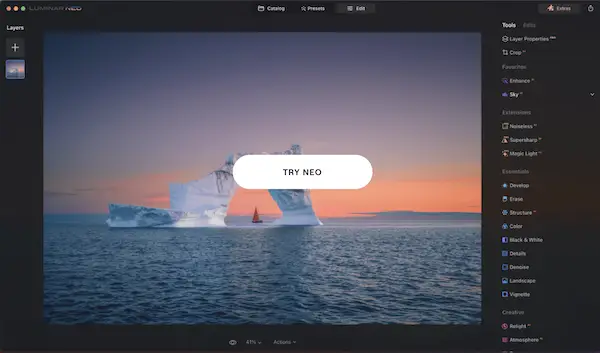
4. Luminar Neo: One-Click Creativity
Not everyone wants to dive deep into complex layers and masks. Luminar Neo has carved out a massive niche as the most beginner-friendly yet powerful AI editor. Its Sky AI is still the gold standard for those moments when the weather didn't cooperate at one of the best photography locations you spent months planning for.
In 2026, Luminar has introduced even more "GenErase" features that allow you to recompose an image by removing entire buildings or objects without leaving a trace. It’s a fantastic tool for landscape photographers who want to spend more time exploring and less time cloning out power lines.
5. Evoto AI: The End-to-End Portrait Solution
Evoto AI has become a massive disruptor in the portrait and fashion world. It’s an end-to-end platform that handles everything from tethering in the studio to the final delivery.
What makes Evoto stand out in 2026 is its "Portrait AI." It can handle high-end skin retouching, body reshaping, and even digital makeup in a way that looks incredibly natural. For high-volume headshot photographers, this has turned a week-long turnaround into a same-day delivery. It’s about efficiency without losing the quality that your clients expect from a professional experience.
Integrating AI into Your Travel Photography Workflow
When I’m out exploring travel photography tips or scouting new locations, my workflow usually looks like this:
- The Scout: I use AI-powered apps to predict weather patterns and light placement for specific "photo spots near me."
- The Capture: I focus on the moment, knowing that my technical base is solid.
- The Cull: AfterShoot handles the thousands of frames I inevitably take.
- The Edit: Imagen AI or Luminar Neo provides the base "vibe."
- The Polish: Photoshop or Evoto handles the final 5%: the hero shots that will end up as fine art prints.
The Human Element: Why AI Won't Replace You
It’s easy to look at these tools and think that the art is dying. But here’s the truth: AI doesn't have a story to tell. It doesn't know why you chose to stand in the freezing rain at 4 AM to catch the first light hitting a mountain peak. It doesn't know the connection you made with a subject during a portrait session.
AI handles the math of photography: the exposure, the sharpness, the repetitive clicking. You handle the meaning.
By embracing these tools in 2026, you’re not "cheating." You’re evolving. You’re using the best essential photography gear available to ensure that your creative voice is heard as clearly as possible.
Final Thoughts
The goal of Photoguides has always been to make photography accessible and enjoyable. Whether you’re looking for camera reviews or trying to find the best weekend getaways to test out your new gear, remember that technology is just a tool.
Don't let the technical side of editing overwhelm the joy of creating. Try out one of these AI tools on your next shoot: even if it's just a quick session at a local park. You might be surprised at how much more you enjoy the process when the "work" part of it is handled in a few clicks.
Keep shooting, keep exploring, and most importantly, keep your vision front and center. The future of photography is bright, and it’s a lot faster than it used to be.