
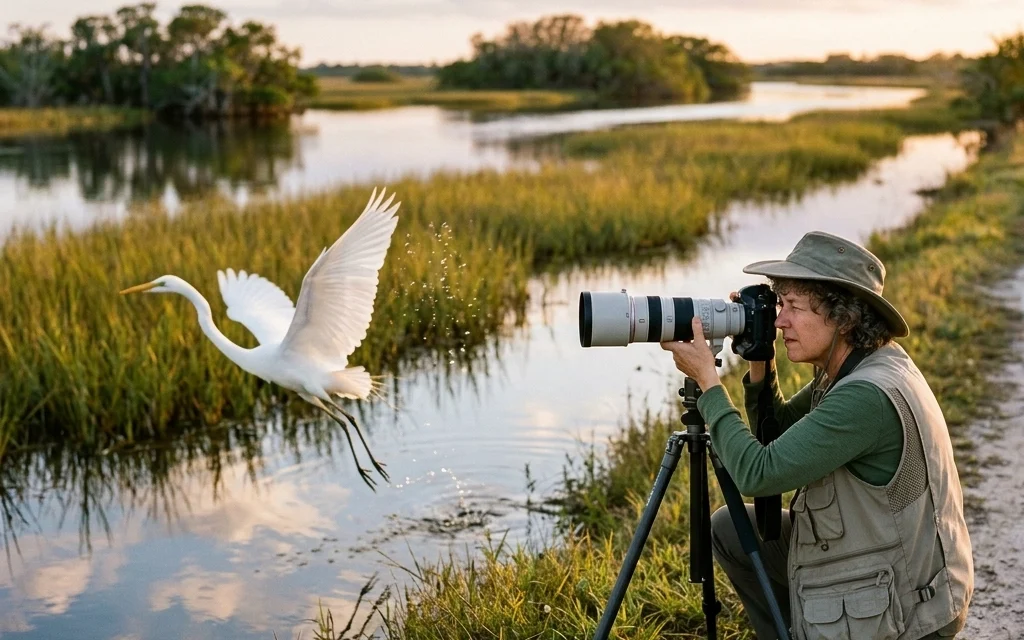
If you’ve ever stood on a boardwalk in the Everglades at 6:30 AM, you know exactly what I’m talking about. The air is thick with humidity, the sawgrass is glowing in that pre-dawn blue, and suddenly, the silence is broken by the prehistoric croak of a Great Blue Heron. It’s a moment that stays with you.
The Everglades National Park is, hands down, one of the premier destinations for bird photography in North America. With over 360 species calling this place home: ranging from the iconic Roseate Spoonbill to the elusive Snail Kite: it’s a literal playground for wildlife photographers. But here’s the thing: the Everglades is massive. It’s a 1.5-million-acre "River of Grass," and if you show up without a plan, you might spend more time driving than shooting.
In this guide, I’m going to break down everything you need to know to come home with professional-grade bird photos, from the gear you should pack to the secret spots that never disappoint.
Why the Everglades is a Bird Photographer’s Paradise
Unlike many other wildlife hotspots where you’re squinting through binoculars to see a speck on the horizon, the birds in the Everglades are often quite habituated to humans. Along trails like Anhinga or Shark Valley, the wildlife is often just a few feet away. This proximity allows for intimate portraits that capture every detail of a bird’s plumage and the glint in its eye.
However, "easy" access doesn't mean "easy" shots. The harsh Florida sun, busy backgrounds of tangled mangroves, and the sheer volume of choices can be overwhelming. That’s why having a solid strategy is key. If you want to skip the trial and error, I highly recommend picking up our Everglades Photography Guide. It’s the result of years of shooting these wetlands and will save you hours of scouting.
The Essential Gear List
When it comes to bird photography, gear matters: but probably not in the way you think. You don't necessarily need a $12,000 prime lens, but you do need "reach."
Lenses: The Long and the Wide
The "sweet spot" for the Everglades is a 200-600mm or 150-600mm zoom lens. These lenses are incredible because they give you the reach to capture a Red-shouldered Hawk high in a cypress tree, but allow you to zoom out quickly when an Anhinga pops up right next to the boardwalk.
Don't forget a wide-angle lens, though. A 16-35mm is perfect for "bird-in-landscape" shots. Sometimes, showing the vastness of the sawgrass prairie with a small Great White Heron in the frame tells a much more powerful story than a tight headshot. You can check out more of my thoughts on essential photography gear here.
Support: Monopod vs. Tripod
While a tripod is great for stability, a sturdy monopod is often the better choice for the Everglades. Many of the best shooting spots are on narrow boardwalks. A tripod can be a tripping hazard for other visitors and is slower to move when a bird suddenly takes flight. A monopod gives you that extra stop of stability while keeping you mobile.

Technical Settings for Success
Capturing a white bird against a dark swamp background is one of the hardest exposures in photography. Here’s how I handle it:
- Shutter Speed: For birds in flight, I never drop below 1/2000s. If it’s a bright day and I’m shooting a Great Egret (which are incredibly fast), I’ll push it to 1/3200s or 1/4000s. This freezes the wingtip motion and ensures the eye is tack sharp.
- Aperture: I usually shoot wide open (f/4 or f/5.6) to isolate the bird from the messy background of the swamp. You want that creamy bokeh to make your subject pop.
- ISO: Don’t be afraid to bump your ISO. In the early morning or under a dense canopy, I’ll go up to 1600 or even 3200. I’d rather have a slightly grainy photo that is sharp than a clean photo that is blurry. Modern noise reduction software is a miracle worker these days.
For more deep dives into technical settings, head over to Shut Your Aperture where we talk gear and technique daily.
Timing is Everything: The Magic of the Dry Season
If you visit the Everglades in the summer, you’re going to get bitten by mosquitoes and probably won't see many birds. The secret to Everglades photography is the Dry Season (December through April).
As the water levels drop across the state, the fish become concentrated in smaller and smaller pools of water. This creates an "all-you-can-eat" buffet for wading birds. They gather by the thousands in these drying pools, making it incredibly easy to find and photograph them. This is also when the birds are in their breeding plumage: the colors are more vibrant, and the behaviors (like nesting and feeding) are at their peak.
Always aim for the "Golden Hour." The first two hours after sunrise and the last two hours before sunset provide that soft, directional light that makes bird feathers look like silk. If you're planning a trip, check out our photography booking experience to see how we can help you get to the right spots at the right time.

Prime Locations You Can't Miss
1. Anhinga Trail (Royal Palm)
This is the "classic" Everglades experience. It’s a short walk, but it is packed with wildlife. You’ll see Anhingas drying their wings, Purple Gallinules walking on lily pads, and more alligators than you can count. It’s best photographed in the late afternoon when the sun is at your back.
2. Flamingo and Eco Pond
Located at the very end of the park road, Flamingo is where the freshwater meets the saltwater. This is the best place to find Ospreys, Bald Eagles, and the famous Roseate Spoonbills. Check the tide charts; low tide at the mudflats near Flamingo can be a goldmine for shorebirds.
3. Shark Valley
Rent a bike or take the tram. The 15-mile loop at Shark Valley offers incredible vistas and a high concentration of herons and egrets along the canal. The observation tower at the halfway point also gives you a unique "bird's eye view" of the landscape.
For a full list of my "secret" spots and GPS coordinates, the Everglades Photography Guide is your best friend.
Composition and Ethics
When you’re out there, it’s easy to get "telephoto tunnel vision." Remember to step back and look at the whole scene. Try to get down to the bird’s eye level. If you’re shooting from a boardwalk, crouch down. Shooting at eye level creates a connection between the viewer and the subject that you just don't get when looking down on a bird.
Most importantly, respect the wildlife. The Everglades is a fragile ecosystem. Never "flush" a bird (scaring it into flight) just to get a wing-spread shot. If a bird looks stressed or stops its natural behavior because you’re too close, back off. The best photos are of birds acting naturally, not reacting to a human.

Final Thoughts
The Everglades is a place of endless stories. One day you might be focusing on the intricate patterns of a Green Heron’s neck, and the next, you’re capturing a massive Wood Stork catching a fish. It requires patience, a bit of sweat, and a lot of memory cards.
If you’re looking for more inspiration or want to see some of the work I’ve done in the park, visit my fine art gallery at Edin Fine Art. You can also find more travel and photography tips on my main blog at Edin Chavez Blog.
Ready to pack your bags? Make sure you have the Everglades Photography Guide downloaded on your phone before you head into the park (cell service is spotty out there!). It’s the ultimate tool to ensure you don’t miss a single shot.
Happy shooting, and I’ll see you out in the swamp!














